News is updated regularly. For real-time updates follow us on social media.
Social Media & Online Presence
- BlueSky: @maccoss.bsky.social
- LinkedIn: MacCoss LinkedIn
Lab News & Updates
Subscribe to our RSS feed for automatic updates: RSS Feed
Recent News
Lauren Fields Selected as 2026 Schmidt Science Fellow
Congratulations to Lauren Fields, a postdoctoral fellow in the MacCoss Lab, who has been selected as a 2026 Schmidt Science Fellow! The Schmidt Science Fellowship is a highly competitive program that supports the next generation of science leaders working on the world’s most pressing problems. Fellows are chosen for their potential to make a significant impact through interdisciplinary research.
As a Schmidt Science Fellow, Lauren will use advanced mass spectrometry and protein analysis of clinical blood and cerebrospinal fluid samples to search for earlier diagnostic markers for amyotrophic lateral sclerosis (ALS). This work could pave the way for earlier intervention and the development of therapeutics that alter the trajectory of the disease.
Lauren earned her PhD in Chemistry from the University of Wisconsin-Madison in December 2025, where she worked with Professor Lingjun Li on neuropeptide detection strategies using mass spectrometry. As a Schmidt Science Fellow, she will pivot from analytical chemistry into proteomics and genomics, bringing her expertise in mass spectrometry to bear on one of the most challenging problems in neurodegenerative disease research.
Read more about Lauren’s work in the UW-Madison Graduate School press release and learn about the full 2026 cohort of Schmidt Science Fellows.
awards fellowship schmidt-science-fellows
TaMADOR Consortium Launches New Website
The TaMADOR consortium has launched a new website at tamador.org. TaMADOR — Targeted Mass Spectrometry Assays for Diabetes and Obesity Research — brings together research groups funded by two NIDDK programs to develop and disseminate targeted mass spectrometry assays for the diagnosis and monitoring of Type 1 Diabetes and Obesity.
The consortium includes four participating institutions:
- University of Washington (PIs: Andrew Hoofnagle, Michael MacCoss) — Quantifying proteins in plasma to democratize personalized medicine for patients with Type 1 Diabetes
- PNNL & University at Buffalo (PIs: Jun Qu, Wei-Jun Qian) — Robust mass spectrometric protein/peptide assays for Type 1 Diabetes clinical applications
- Cedars-Sinai Medical Center (PI: Jennifer Van Eyk) — Design and validation of easy-to-adopt mass spectrometry assays of importance to Obesity
- Pacific Northwest National Laboratory (PI: Wei-Jun Qian) — Multiplex mass spectrometric protein assays for precise monitoring of the pathophysiology of Obesity
The site features publications, datasets, meeting information, and links to the Panorama data repository. Check it out at https://tamador.org.
tamador targeted-proteomics diabetes obesity
Frontiers in Proteomics: Advanced Skyline Applications — 2026 Course in Seattle
We are pleased to announce an all-new advanced course: Frontiers in Proteomics: Advanced Skyline Applications, taking place July 6–10, 2026 at the Foege Building, University of Washington, Seattle.
This year’s curriculum has been completely redesigned for experienced Skyline users looking to deepen their expertise across advanced quantitative proteomics topics. Through lectures, hands-on exercises, and guided discussions, participants will explore:
- System suitability and quality control strategies
- Statistical methods for designing and analyzing advanced DIA experiments
- AI-driven workflows
- The Skyline software ecosystem and integrating external tools effectively
- Experiment design tailored to your own research goals
The instructor list includes researchers and software developers from the MacCoss Lab, alongside experts with extensive experience in targeted and quantitative proteomics — a unique opportunity to learn directly from the creators of Skyline.
- Who: Experienced Skyline users
- When: July 6–10, 2026
- Where: Foege Building, University of Washington, Seattle
- Cost: Academic: $500 | Industry: $1250
- Participants: 30
- Apply by: April 1, 2026
Registration includes course materials, refreshments, and a course dinner. Participants are responsible for their own travel, lodging, and meals.
Apply now or see the full course details and schedule.
courses skyline proteomics
Mike, Nate, and Bill Receive USHUPO 2026 Awards in St. Louis
At this week’s US HUPO 2026 conference in St. Louis, Missouri, three members of our extended community officially received their awards. Congratulations to Mike MacCoss, Nate Basisty, and Bill Noble!
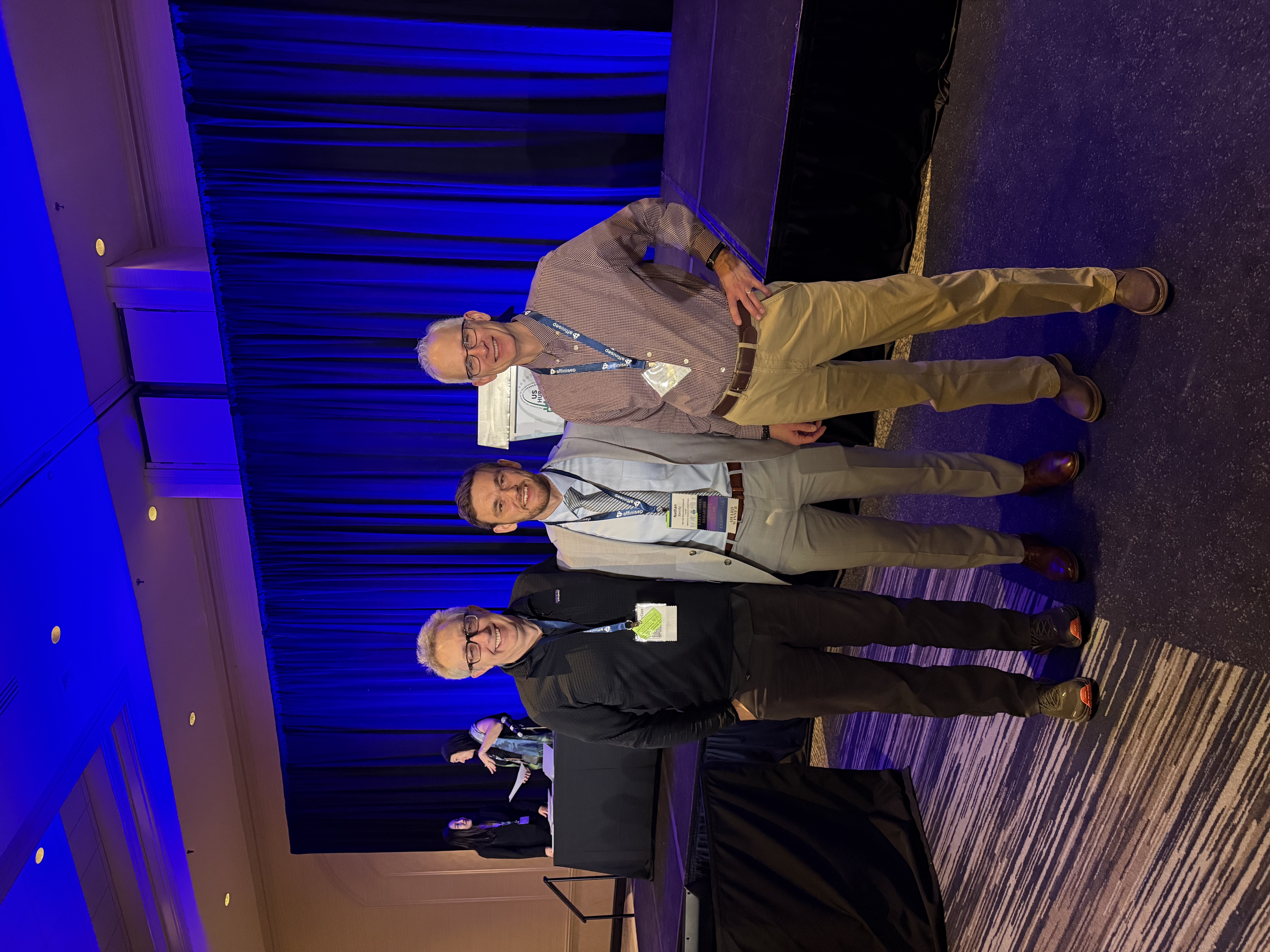
Mike MacCoss received the Donald F. Hunt Distinguished Contribution in Proteomics Award, recognizing his outstanding contributions to the field of proteomics, including his scientific achievements and dedication to mentorship and improving equity and inclusion within the community.
Nate Basisty, a former MacCoss lab trainee who completed his Ph.D. at UW co-mentored by Peter Rabinovitch and Mike MacCoss, received the Robert J. Cotter New Investigator Award. Nate is now an NIH Distinguished Scholar and Tenure Track Investigator at the National Institute on Aging, where his Translational Geroproteomics Unit works at the intersection of proteomics and translational aging biology.
Bill Noble, one of our closest colleagues in the Department of Genome Sciences, received the Gilbert S. Omenn Computational Proteomics Award, recognizing his tremendous contributions to machine learning and statistical methods for analyzing shotgun proteomics data.
We are incredibly proud of all three awardees. What a wonderful representation of our community!
awards ushupo proteomics
Multiplex Targeted Proteomics Paper Published in MCP
Deanna Plubell’s paper on Development of highly multiplex targeted proteomics assays in biofluids using a nominal mass ion trap mass spectrometer is now published in Molecular & Cellular Proteomics. This work was done during Deanna’s postdoc in the lab and was a fantastic collaboration with our Thermo colleagues Phillip Remes, Cristina Jacob, and Lilian Heil, as well as our neurodegeneration collaborators Kathleen Poston and Tom Montine. The paper demonstrates the generation of large-scale targeted assays using the Stellar mass spectrometer, with applications to cerebrospinal fluid and Mag-Net enriched plasma extracellular vesicles for neurodegenerative disease research.
publications MCP targeted-proteomics Stellar
Mike MacCoss Featured on The Proteomics Show Podcast
Mike MacCoss was recently interviewed on “The Proteomics Show” podcast leading up to USHUPO 2026. The discussion covers topics in proteomics research and mass spectrometry.
The episode is available wherever you get your podcasts, or you can listen directly on Spotify.
podcast interview USHUPO
Skyline Webinar 27: Peak Boundary Imputation for DIA Data
We hosted our third Skyline webinar of 2025 with over 153 participants joining Michael MacCoss and Nick Shulman on December 11th. The webinar introduced the newest Skyline tutorial on Peak Boundary Imputation for DIA Data.
Mike presented a case for imputing boundaries for missing DIA data, and Nick demonstrated the technique using Skyline. The session concluded with a great Q&A that generated many excellent questions and will lead to more discussion in a future webinar.
The webinar recording, slides, tutorial, and data set are available on the Skyline Webinar 27 page.
webinar skyline DIA
MacCoss and MacLean Named to Clarivate Highly Cited Researchers 2025 List
Michael MacCoss and Brendan MacLean have been recognized on the 2025 Clarivate Highly Cited Researchers list. This list identifies researchers who have demonstrated significant and broad influence in their fields through the publication of multiple highly cited papers over the last decade.
The University of Washington had 56 faculty and researchers named to this year’s list across various fields. The Clarivate Highly Cited Researchers list recognizes world-class researchers selected for their exceptional research performance, demonstrated by production of multiple highly cited papers that rank in the top 1% by citations for their field and year.
This recognition reflects the significant impact of the MacCoss Lab’s work in mass spectrometry and proteomics, particularly the development of widely-adopted tools like Skyline and contributions to quantitative proteomics methodology.
Read more about the 2025 Clarivate Highly Cited Researchers at UW.
awards recognition highly-cited-researchers clarivate
MacCoss Lab Celebrates USHUPO 2026 Award Winners
We are thrilled to announce that Mike MacCoss has been selected to receive the 2026 Donald F. Hunt Distinguished Contribution in Proteomics Award from US HUPO. This award recognizes outstanding contributions to the field of proteomics based upon scientific achievement as well as contributions to mentorship and improving equity and inclusion within the field. Mike will present at the US HUPO conference in St. Louis, Missouri (February 21-25, 2026).
We are also proud to celebrate two others closely connected to our lab who are receiving 2026 US HUPO awards:
Nate Basisty, a former MacCoss lab trainee who completed his Ph.D. at UW co-mentored by Peter Rabinovitch and Mike MacCoss, has been selected for the Robert J. Cotter New Investigator Award. Nate is now an NIH Distinguished Scholar and Tenure Track Investigator at the National Institute on Aging, where his Translational Geroproteomics Unit works at the intersection of proteomics and translational aging biology. We are so proud of Nate’s continued success and his dedication to the proteomics community.
Bill Noble, one of our closest colleagues here in the Department of Genome Sciences, has been selected for the Gilbert S. Omenn Computational Proteomics Award. This award recognizes scientists who have developed bioinformatics, computational, statistical methods, and/or software used by the proteomics community. Bill’s contributions to machine learning and statistical methods for analyzing shotgun proteomics data have had an enormous impact on the field.
Congratulations to all three awardees!
awards ushupo proteomics
Orbitrap Astral Zoom Paper Published
Excited to see this latest paper published in JPR. For years we’ve wanted a simple way to standardize the signal between mass spectrometry instrumentation. Here we use the precision of an intra spectrum ratio to assess the relationship between the reported signal and the number of ions. We use this strategy to assess the improvement in the Orbitrap Astral Zoom over the original and to evaluate the effect of different acquisition strategies. Looking forward to seeing others apply this approach in the evaluation of other instruments. Great work by graduate student Chris Hsu.
publications journal of proteome research astral